Web Design Blog

Author: admin

  • Adapt.js: JavaScript Alternative to CSS Media Queries

    Adapt.js is a JavaScript library (or framework) that helps you design web sites for mobile devices:

    For many developers that means using @media queries to selectively target the device screen size and orientation through CSS.

    While the @media approach is a good one, it won’t work for every site. That’s why Nathan Smith, creator of the 960 Grid System, has released Adapt.js, a lightweight JavaScript library (894 bytes minified) that allows you to specify a list of stylesheets and the screen sizes for which they should be loaded. Essentially Adapt.js does the work of @media, but will work in any browser, even those that don’t understand @media.

    … While using JavaScript to load CSS might seem a bit strange, even if you use @media queries you’re still going to need some kind of polyfill (usually JavaScript-based) to handle those browsers that don’t know what to do with @media rules.

    Scott Gilbertson @ Webmonkey

  • Scandanavian Web Design

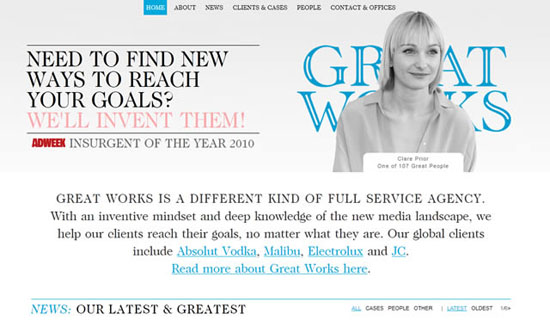
    GreatWorks.se

    We’ve gathered two dozen examples of exemplary clean, simplistic and minimal web designs from the Scandinavian countries, Denmark, Sweden, Finland, Norway and Iceland.

    Darren Stevens @ speckyboy.com

  • GE Demands Removal of Hoax Website

    Fair use parody? Or phishing, copyright and trademark infringement?

    It seems GE isn’t laughing about the hoax implemented by the Yes Men and US Uncut. Yesterday, the activist groups posted a fake press release allegedly from GE stating the company intended to donate its entire $3.2 billion tax refund to the US Treasury. The website, genewscenters.com, is a fake website hosted by BlueHost (the real GE-owned website is genewscenter.com).

    GE immediately demanded the hoax website be taken down, which US Uncut views as an attack on their freedom of speech. Bryan Fansler, GE’s deputy chief information security officer, contacted Bluehost and, according to US Uncut, “waved some scary sounding legal phrases,” and successfully got Bluehost to take down the site for “a combination of Phishing, Copyright and Trademark infringement.”

    Duncan Meisel, a US Uncut representative, calls this a violation of the group’s First Amendment rights. “[Fansler] isn’t a lawyer,” says Meisel. “This is a case of straight-up intimidation to silence criticism of one of America’s largest and most important corporations.”

    Furthermore, Meisel believes there is precedent to use GE’s likeness in a satirical fashion. “Our right to fair use of their logo, copyright and trademarks is far more well established than their shady tax strategy,” says Meisel, adding US Uncut intends to fight the removal of the website

    Allison Kilkenny @ The Nation

  • Create a Comic Book Themed Web Design

    Here’s an excellent tutorial on Photoshop techniques — includes sample code, plenty of screenshots, and detailed step-by-step instructions:

    In Part 1 we will create a very original design for all the comicbook fans out there. We will create this blog layout from scratch using several tricks in Photoshop to make it look awesome. Then in Part 2 we will learn how to slice it, code it, and get it ready to be converted into a blog CMS theme.

    Alvaro Guzman @ Webdesigntuts+

    Note that Part 2 is not yet published.

  • Curation Ecosystem

    The essay below describes a “curation ecosystem” — that is, web content which is cataloged, cross-referenced, rated, filtered, and otherwise managed by human beings.

    [T]he entire curation ecosystem is growing and along with it there has been an will continue to be a proliferation of interesting tools that people can use to help filter, organize, archive discover and share content on virtually any topic.

    How useful any one tool might be depends heavily upon the intended use. Some are designed to help curate (or in my own opinion) more artfully filter real time streams -– most especially twitter however I think this form of curation is actually closer to aggregation unless those lists of tweets and other content and subsequently perused by a person and further refined. In fact I would go so far as to argue that a purely algorithmic effort at filtering content should really be described as aggregation and not truly curation.

    The way I see it you wouldn’t have an algorithm choose the most important 10 pieces of French Impressionist art out of a 10,000 item collection. Could an algorithm really determine not only why they were the most important pieces but also make decisions about how to display them in a way that places them in context with one another as well as within the larger context of the entire period?

    Perhaps the day when that will happen isn’t far away but as someone that has followed our progression towards Ray Kurzweil’s “Singularity” it is pretty clear that we’re not there yet.

    On the other hand humans are already very skilled curators. In fact, virtually every one of us curates something. Granted, most of the stuff we curate may not be to your liking -– you may not be as fond of ceramic dogs as my mom is, for example, but that doesn’t mean her collection is any less well curated for that fact -– but when you do seek content on a particular topic it’s highly likely that if you look for material curated by an expert in that area it will deliver far greater value for the time spent to locate it than you are likely to realize using search engines to find material on the same topic.

    osstar @ blogs.reuters.com